Friday, 17 January 2014

Attack of winter

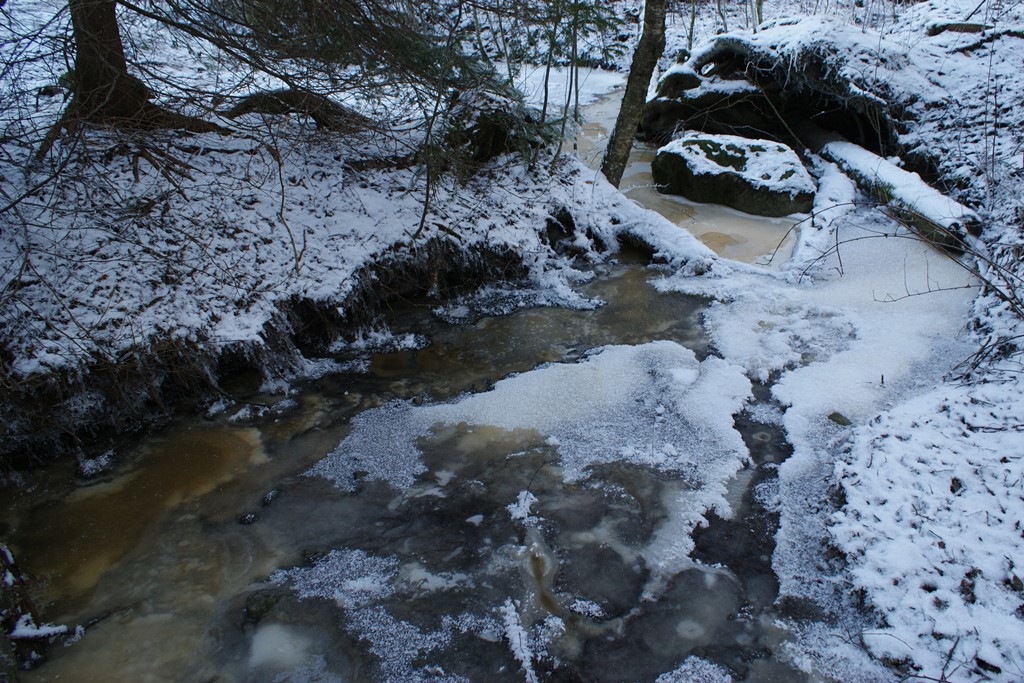
A few days ago, winter finally arrived. What an attack it was! Only last week it was raining and pouring and now we’ve had to take temperatures 20 degrees colder (35 in Fahrenheit). The thermometer suddenly dropped to around -15°C (5°F) and has stayed there for days.


The north-facing house wall is covered in ice crystals.
They reported in the news that it will only take a week for the human body to get used to this kind of a change. Had they met me they would have made it clear they were talking about the average person’s ability to adjust. I am afraid I will never be average when it comes to standing the cold.


At least we now have some snow, which is a welcome consolation. Even a very thin layer will make a big difference. Not to mention the sun that has recently been reminding us of its existence daily!


Do you see the skull formed by the roots of a tree that is no longer there?
Despite the frosty weather, water is still running from the surrounding fields to the creek flowing through our plot. A neighbour who knows about these things told me that soil will freeze only for the depth of two centimetres per day. So even in these kinds of conditions it will take a while for the frost to reach the subsurface drainage system.


Tuesday, 14 January 2014

Grand dreams

If you ask me, the most fascinating work at the recent Lux Helsinki 2014 event was a light installation called Edges of Dreams. It was projected onto the facade of the Hakasalmi Villa, one of the Helsinki City Museums that used to be a private residence.

The installation was created by Mika Haaranen, a lightning and set designer and photographer, who had been inspired by the history of the pink villa and its inhabitants. It was compiled of reflections of painted film and shadow patterns with accompanying music composed by Aake Otsala.


The Hakasalmi Villa was built in the 1840s by a prominent Finnish figure and high official in the Grand Duchy of Finland, Carl Johan Walleen. Today the building is only a stone’s throw away from the very heart of the city but at that time it was a bit away from the centre by the Töölö Bay, in other words practically in the countryside. The villa, however, lost its access to the waterfront when the country’s first railroad was constructed in the early 1860s.


During its 170 years, the villa has seen the surrounding town grow into a metropolis, not a large one in present-day standards but a metropolis anyway. It has also witnessed misery, such as the great famine of the 1860s plus a couple of wars but before all that it was part of the glamour and refinement of the aristocracy.

The building is still sometimes referred to as the Karamzin Villa because of its best-known owner and last resident Aurora Karamzin(a) born Stjernvall (1808-1902), the stepdaughter of its builder. She was a Finnish noblewoman renowned for her beauty who lived an amazing life that took her everywhere from the Emperor’s Winter Palace in St Petersburg and villas and palazzi in France and Italy to mining sites in the Ural Mountains.


To make a long story short, Aurora acted as a lady-in-waiting for the Empress of Russia; married a divinely rich Russian prince and imperial master of the hunt Pavel (Paul) Demidov; was widowed at the age of 31 with a baby boy; and as the guardian of her son suddenly had control over enormous assets.

Aurora’s husband died in 1840, which was the year she also lost her mother and one of her sisters. She needed to feel at home and bought the family’s Träskända Manor in Espoo some 20 km out of Helsinki from her stepfather. Incidentally, it was this transaction that provided Walleen the means to build the Hakasalmi Villa.


Later Aurora married captain Andrei Karamzin; developed a serious interest in social issues, for example, starting social reforms at her late husband’s mines and foundries in the Ural; was widowed again at 46; and continued her social pursuits throughout the rest of her long life supporting and working for numerous charitable causes both in her homeland and abroad.

When travelling, Aurora used to visit the local charitable institutions and hospitals to learn about their activities. This was how she familiarized herself with nursing and the first ever deaconess institute that was established in the Rhineland. In the 1860s, she founded The Helsinki Deaconess Institute that is still very much active and highly valued as an important non-profit foundation providing social, health care and educational services.

The lavish lifestyle and self-absorbed character of Aurora’s only child Pavel or Paul was a constant worry for her. Paul died in Florence at the age of 46, 17 years prior to his mother. She lived her later years in the Hakasalmi Villa and left it to the City of Helsinki. For more than a century now, the building has served as a museum, currently as the City Museum with changing historical exhibitions.


Aurora Karamzin’s life was magical like a brilliant film plot. In fact, the Finnish director Maarit Lalli is preparing a script and filming is scheduled for 2015. The working title is ‘Le Grand Sancy’, which refers to the diamond of the same name, the 7th largest in the world that Pavel Demidov gave Aurora as one of the morning gifts. The diamond of 55.23 carats is believed to be of Indian origin but its history is known only from around 1570. It was sold to the Louvre museum in the 1970s by its last private owners, the British Astor family.

I very much hope Ms Lalli will manage to raise the money required to make the kind of movie the extraordinary lady, wonderful personality and pioneering philanthropist deserves.


(And I do hope Mr Haaranen will learn to use a proof-reader to avoid further annoying spelling mistakes. A live show does not draw your attention to such details, at least if you are watching from behind a maple tree, but photos are ruthless.)

By the way, Aurora’s son inherited his uncle’s title Prince of San Donato (as per his Villa San Donato in Florence). The title was created for Anatoly Demidov by Leopold II, Grand Duke of Tuscany, so that Mathilde Bonaparte, the daughter of Napoléon’s brother Jérôme, would not lose her title of princess when marrying him. If anyone of you has visited Portoferraio on Elba, Anatoly was the same Demidov who built the museum below Napoléon’s private house Villa di San Martino, the ghastly museum that completely ruins the site’s historical and artistic value.


Saturday, 11 January 2014

Pinballing and more

Returning to the Lux Helsinki event we attended a few days ago, my second stop was the New Student House and the Urban Flipper by the French CT Light Concept. They had turned the facade of the building into a giant pinball game operated by one viewer at a time. Just like the Corazón I showed in my previous post here, this work has also been seen earlier at the Lyon Fêtes des Lumières, in this case in 2011. The visuals changed between every game but I didn’t have the patience to watch more than the single one captured on my video.


The Lux Ratikka tram by Riikka Karjalainen and Alexander Salvesen revisited from last year to tour along the downtown rails as a moving, ever-changing light installation.


The Swedish language newspaper Hufvudstadsbladet or Hbl had joined the event to mark their 150th anniversary year. The tower of their offices was turned orange by lightning designer Jukka Huittila’s arrangement.


There was much more to see; for example, a lantern park with some 150 lanterns made by art and design students as well as professionals, a 25-min performance of a fire circus, for the first time even a light art exhibition at the Cable Factory cultural centre, which we were thoughtless enough to skip. But I saw one more work I was so impressed with I must post about it. See you soon.

In the foreground, Kiasma, the Museum of Contemporary Art by Steven Holl.

Friday, 10 January 2014

I heart Helsinki

Now that the weather has gone all wild in America, it seems to be equally confused around here: the unusually mild but depressingly wet and grey conditions have continued. Nevertheless, we haven’t let ourselves be completely discouraged. For example, we spent the whole of Wednesday in Helsinki. First we ran some errands – who could resist spending an hour or two in a good bookstore when the sale is on – while waiting for the clock to strike 5. It was the last night of the 5-day Lux Helsinki light festival and that was the time when the light installations were switched on.

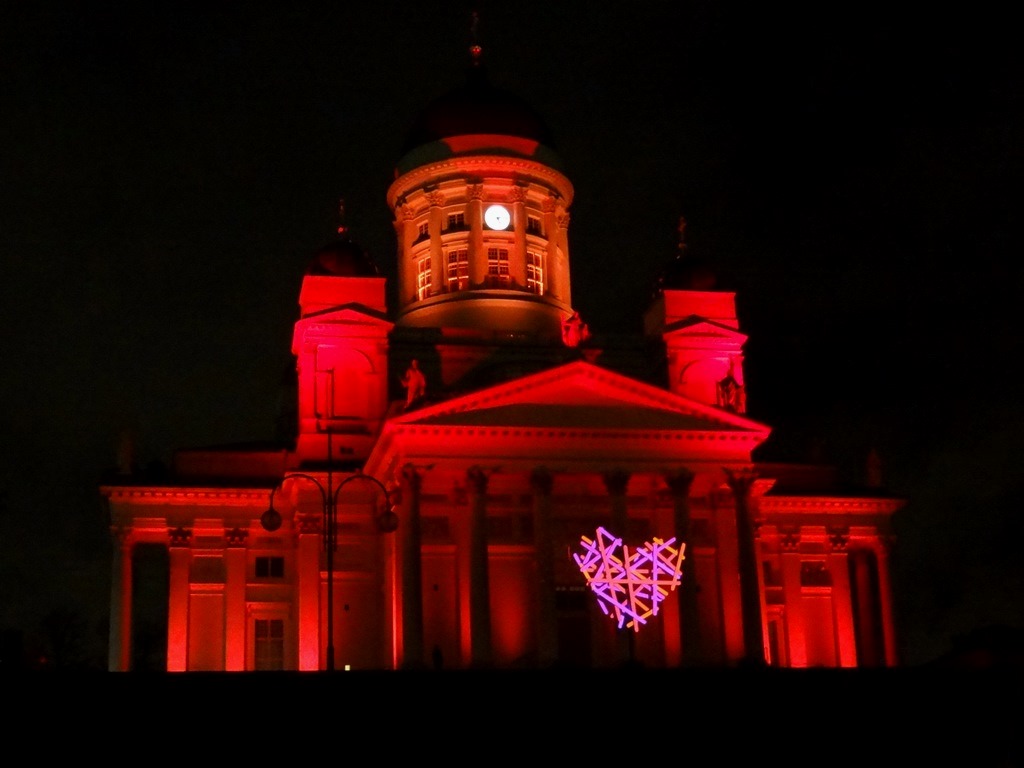
I had decided to start the tour at the Senate Square expecting to see something spectacular as the Helsinki Cathedral offers such a remarkable setting to play with light and colours. This time, it was a huge graphic heart at the top of the stairs rising from the square to the cathedral, a heart beating in countless colours with the colour-lit cathedral as a dramatic chancing background.


The installation entitled Corazón was designed by the Spanish fashion designer and cultural figure Agatha Ruiz de la Prada in collaboration with the production and design company D-Facto from Lyon, France. The installation was first seen at the Fêtes des Lumières in Lyon in 2012.


I shot a video but I am sorry it didn’t catch much of the music that was composed specially for this work. Moreover, it seems YouTube has made some changes since I last used it. The uploaded video is of considerably poorer quality than my original (so are the photos on Blogger by the way) but I am posting it anyway.


More to follow on Lux Helsinki 2013 in a day or two.

Have a look also at my post about the light installation Lux Helsinki showed at the Senate Square in 2013 here


Monday, 6 January 2014

Heritage of friars

Here, 2014 has started as grey as ever but back to the turn of the year for a while. We spent the eve at our friends’ in Rauma, the ones with whom we travelled to both Catalonia and Rioja in 2012. In fact, we were so well entertained we stayed for two nights.

Our ties with Rauma are rather tight. I lived there all through the 1980s and both my children were born there. Less than a decade ago, it was still my husband’s hometown and his son lives there even today. When leaving for home I suddenly felt an urge to visit the church, mainly because of some artworks I wanted to see.


When I was expecting my first-born I walked this path every day on my way to work.

The location of the church is quite picturesque: by a small stream, the so-called Rauma river, north of the historical wooden Old Rauma, which is a UNESCO World Heritage Site.

It is not certain which was first, the Franciscan convent or the settlement that later became the town. Rauma was established in 1442, which makes it one of the oldest towns in our country. The present parish church, the Church of the Holy Cross, dates back to at about 1500 when the Franciscans built it to replace their wooden shrine. Protestant reformation drove the friars away in the late 1530s and for a century the buildings had no religious use but served the Crown.


In 1640, the stone church of the Franciscans was finally put into service as a Lutheran church when a fire – one of the many that have wiped out the wooden town over the centuries – destroyed the then parish church on the southern side of the old town. The bell tower was added only some 200 years ago built using stones recovered from the burnt church.

I find the interior of the Rauma church one of the most beautiful in our country thanks to the decorations and artworks reminding about its Catholic past. Even my poor photos reveal hints of its splendour.

The colourful murals on the walls and vaults of the choir date from the early 16th century, from the time of our last Catholic bishop. I didn’t even try to photograph them in the twilight. The pulpit is a rare wood-carved Renaissance piece made in northern Germany in 1625. The huge 24-arm brass chandelier is a donation from 1648.


The wood-carved triptych altarpiece is another donation made in the early 17th century. It is most likely a Prussian piece from the 1440s. It now serves as the altarpiece for a side altar that was recently arranged in the northern nave of the church.


The church also boasts a few votive paintings or epitaphs, such as the large baroque one of the Sonck family from 1653 pictured above. The two coats of arms decorating the balusters of the northern gallery are so-called funeral hatchments.

The apostles Peter and John.
The paintings on the railing of the galleries represent the apostles and the texts tell about their martyrdom. They were painted by Jonas Bergman from Turku in the 1760s.


Actually, the reason for my visit was the lonely old lady sitting on the bench with a hymnal in her hand. Did you notice her in a couple of the above photos? She is a piece by the local ceramic sculptor Kerttu Horila I posted about some time ago (here). Adorable, isn’t she?


There was also a nativity scene by her at the entrance to the church, and another rag doll style for the little ones in the space that served as a side entrance once. It is delightful that cribs have entered also our churches, although often not further than the vestibule.

It is Epiphany, the end of the festive season. By the time I post this the cribs have been removed and stored for another 11 months. St Francis of Assisi will continue his guard facing the Church of the Holy Cross. ‘Lord, make me an instrument of Thy peace.’ I am sure that is what he is thinking about when stroking the bird in his hand, even though the prayer commonly attributed to him was first published as late as in 1912.

The sculpture of St Francis of Assisi by Jussi Vikainen is from the 1970s.